Does your platform support integration to LLMs and Generative AI?
Yes, Teneo can integrate with any LLMs and RAG models just as it can with any external service that allows interface via modern methods such as web services, allowing access to functionalities like classification, sentiment analysis, and dynamic answer creation.
Does your platform support implementation of FrugalGPT? If so, please describe.
Yes, Teneo allows implementation of FrugalGPT methodology such as cascading LLMs or answer caching which can reduce costs by up to 98%.
How do you handle user data privacy and security concerns when using LLMs in your platform?
Teneo implements robust PII anonymization protocols and adheres to ISO-certified security standards. By doing this, sensitive data is masked before it is sent to the LLM, ensuring no exposure to external tools while maintaining the AI solution's functionality.
How are hallucinations in LLMs mitigated?
Teneo generates personalized responses based on an individual’s unique experiences and circumstances. This customization is particularly effective in addressing LLM hallucinations, as it tailors responses to meet specific user needs.
What mechanisms are in place to prevent the generation of inappropriate or harmful content?
Teneo employs robust filters designed to detect and block malicious patterns, protecting against prompt hacking and injection attempts. Additionally, custom filters can be created to target specific words or phrases, ensuring harmful inputs are intercepted before they reach the LLM or voice chatbot.
Do you support RAG (Retrieval Augmented Generation)?
Yes, Teneo is LLM agnostic and integrates with any RAG model and LLM, including Google Gemini, Anthropic Claude, and OpenAI. Teneo also supports FrugalGPT methodology, reducing Generative AI costs by up to 98% through techniques like cascading LLMs or reusing answers.
Can I integrate Knowledge AI with Teneo?
Yes, you can integrate your own Knowledge AI with Teneo. This allows you to enhance your existing IVR with more AI capabilities and combine them with Teneo's advanced conversational platform.
How do you measure and track the performance of your LLM-based solution over time?
Performance can be captured in Teneo Inquire using Teneo Query Languages. Teneo provides connectors to PowerBI, Tableau, and other BI tools, allowing for detailed performance tracking.
How does your system optimize LLM performance for different use cases?
Teneo.ai dynamically selects the most appropriate LLM based on task requirements like complexity, domain, and cost-efficiency. It leverages the Teneo Accuracy Booster for precision and tailors model usage through customizable workflows for optimal performance and resource utilization.
How do you handle scaling up to accommodate high-volume requests across multiple LLMs?
Teneo.ai employs a flexible cloud-based architecture that supports dynamic resource allocation. It automatically scales to accommodate high-volume requests by distributing tasks across multiple LLMs, ensuring optimal load balancing and high performance.
How does the platform maintain performance as the number of LLMs increases?
Teneo maintains performance by using an intelligent orchestration layer that efficiently manages task distribution and load balancing across models. The platform optimizes resource allocation, dynamically selecting the best-performing LLM for each task while avoiding bottlenecks.
What strategies are used to reduce latency when scaling LLM usage?
Teneo.ai reduces latency through intelligent task routing, load balancing, local caching of frequent requests, and streaming responses. It also utilizes parallel processing and optimized API calls to ensure low-latency performance during high-volume usage.
How does the platform ensure that high-performing models are prioritized for critical tasks?
Teneo.ai uses its intelligent task routing system and FrugalGPT approach to prioritize critical tasks for the most accurate and reliable models. Less demanding tasks are handled by more cost-effective models, ensuring essential tasks are handled by the best-suited models without compromising efficiency.
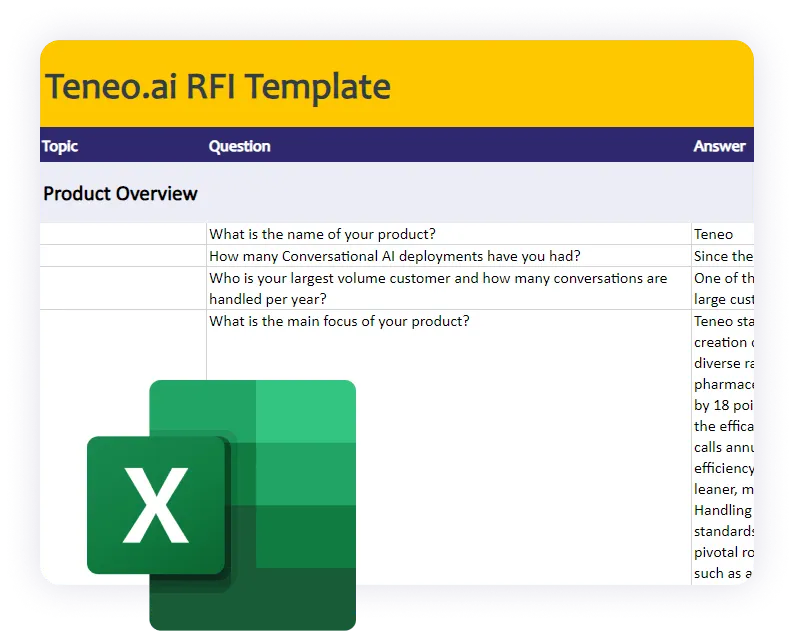
What is the name of your product?
Teneo
How many Conversational IVR deployments have you had?
Since the launch of Teneo, we have deployed hundreds of solutions.
Who is your largest volume customer and how many conversations are handled per year?
One of the Global Tech Giants is handling about 20 million phone calls per year. Telefonica Germany is another large customer handling about 12 million conversations per year.
What is the main focus of your product?
Teneo stands as the leading conversational automation platform in the enterprise sector, specializing in the creation of sophisticated, interconnected systems for Interactive Voice Response (IVR), Conversational IVR, and LLM Orchestration. Our global customer base spans diverse industries, including insurance, banking, automotive, utilities, retail, fast-moving consumer goods, pharmaceuticals, and consumer goods. Swisscom's adoption of our platform has resulted in an impressive 18-point increase in the Transactional Net Promoter Score (NPS), demonstrating the significant impact of conversational automation on customer satisfaction and loyalty. With over 9 million calls annually managed through our platform, we have showcased substantial operational scalability and efficiency. This optimization has led to better resource allocation and reduced overhead costs, creating a leaner and more agile operational model. Our collaboration with Telefónica marks a significant advancement in customer experience innovation. Managing nearly one million voice-based and 200,000 text-based customer interactions monthly, we have set new benchmarks in responsiveness and customer satisfaction.
What is the target industry sectors that your product specializes in?
Teneo is designed to be industry-neutral, offering an ideal choice for any organization aiming to engage with individuals more naturally. With its comprehensive intent collections and ready-made solutions with connectors tailored for different sectors, Teneo facilitates a swift initiation into successful IVR and voice chatbot projects.
What are the primary voice chatbot building features offered by your product?
Teneo is a versatile LLM Orchestration platform designed for crafting sophisticated, integrated virtual agents for both customers, IVR’s and employee services across chat and voice channels in the enterprise sphere. It empowers business users to design conversations that closely mimic human interactions through its graphical conversation editor. This tool leverages the capabilities of the Teneo Natural Language Understanding (NLU) technology in a user-friendly format, eliminating the necessity for coding with easy-to-use, drag-and-drop features. We operate in a combined model where Teneo can be trained to both manage structured business logic as well as using LLM and Generative AI to best serve the counterpart (End-client or agent).
What skills does a bot developer require to use your product?
Teneo is tailored for users without a technical background, providing an extensive array of tools for building conversations, training in Natural Language Understanding (NLU), and integrating with third-party services, all which demand little to no programming skills.
What is the architecture of the LLM Orchestration solution?
Teneo.ai's LLM Orchestration solution follows a modular architecture, designed for flexibility and scalability. It integrates with multiple LLMs via APIs, with a centralized orchestration layer as Teneo that intelligently routes requests to the most suitable model based on task requirements.
Can the system orchestrate both proprietary and open-source LLMs?
Yes, Teneo can orchestrate both proprietary and open-source LLMs. The platform integrates seamlessly with models like GPT-4, Google Gemini, and open-source options like Meta LLaMa, allowing dynamic model selection based on task requirements. It supports hybrid environments to optimize performance and cost.
How does Teneo improve productivity for data analysts?
Teneo boosts the efficiency of data analysts by leveraging its Query Language (TQL) to access detailed information captured during interactions. This capability allows for the seamless integration of conversational data into BI tools like PowerBI and Tableau, offering analysts a powerful tool for visualization and analysis.
How does Teneo improve productivity for developers and trainers?
Teneo improves productivity for users by utilizing an optimization loop, which involves using real-life conversational data to refine and improve your voice chatbot and RAG implementation. By analyzing user data and making enhancements to the voice chatbot, Teneo is able to continuously improve its performance and ensure that it is meeting the needs of its users.
Does the licensing of your solution limit the number of intents, use-cases or bots?
No, Teneo does not limit commercially any of these items, it can be categorized as a fully Enterprise license. Buy once, deploy anywhere.
Is your offering all-in-one or must one license modules individually?
The product is licensed as a whole, with all the modules included.
Is your offering Software as a Service (SaaS)?
Yes, 100% SaaS.
Are there any limitations or restrictions on the types of solutions that can be built with Teneo?
There are no inherent limitations or restrictions on the types of solutions that can be built with Teneo. It is a highly flexible and customizable platform that can be used to build a wide variety of conversational solutions.
Does it cost extra to orchestrate? Who bills each LLM model etc.? Are there limits or caps?
No, LLM costs are managed and maintained by the user. Teneo serves as the orchestration platform that integrates and optimizes the use of your chosen LLM models, whether proprietary or open source. Users are responsible for managing the associated API costs, including setting any usage limits or caps with their respective LLM providers.
How does your solution help minimize costs while maintaining performance?
Teneo.ai helps minimize costs by utilizing Stanford University's FrugalGPT approach, intelligently selecting the most cost-effective LLM for each task without sacrificing performance. Simpler tasks are handled by lower-cost or open-source models, while more complex tasks use advanced models. The platform also supports real-time monitoring and dynamic scaling, optimizing resource use to ensure both cost efficiency and high performance.
Are there any hidden costs (e.g., cloud storage, data processing fees)?
No.
How does Teneo improve productivity for live agents?
Teneo enhances the productivity of live agents through its intelligent agent handover system, which meticulously extracts and consolidates crucial contextual details about a caller before the transfer. This ensures agents receive a comprehensive briefing, equipping them to promptly and effectively address the caller's needs. This approach fosters a more tailored and engaging interaction for the caller, while also conservatively utilizing the agent's time.
How easily can Teneo be scaled up or down to meet changing business needs?
Teneo can be easily scaled up or down to meet changing business needs. Its flexible architecture and cloud-based infrastructure allow for quick scaling of resources. Additionally, Teneo's modular design enhances its scalability and adaptability to changing business needs, making it a powerful solution for businesses of all sizes.
How effective is the NLU for recognizing users' questions?
Teneo's natural language understanding (NLU) outperforms other top competitors in accurately identifying user intent. In a test conducted on Cyara using the Banking77 dataset, Teneo achieved a remarkable 95% accuracy rate. This result significantly surpasses its nearest competitors, who scored 89% and 80%. Additionally, Teneo's user-friendly interface is designed for ease of use, even for those without technical expertise. It enables users to train the system with real-life examples, utilizing advanced machine learning and Teneo's Language Modeling Language (TLML). This combination leads to exceptionally accurate recognition of user intent.
Is the platform able to build on its understanding and learn from customer interactions?
Teneo enhances its comprehension by incorporating misinterpreted phrases into its existing machine learning intent records, subject to user confirmation. Additionally, Teneo has an optimization loop that enables platform users to review and amend any misunderstood inputs to improve the accuracy of the machine learning intents.
How does your system handle ambiguous or unclear user inputs?
Teneo's system addresses ambiguous or unclear user inputs using several advanced techniques. Our NLU engine employs context-aware algorithms that interpret inputs based on the conversation history, significantly reducing ambiguity. If ambiguity persists, the system asks clarifying questions to obtain more specific information from the user. Furthermore, Teneo utilizes fallback mechanisms to steer the conversation back on track, ensuring a smooth and seamless user experience.
Does your platform include an integrated machine-learned classifier?
Yes, our own machine learning classifier is included with Teneo, along with a native connector with Azure Conversational Language Understanding (CLU).
Can your platform integrate with external NLU tools such as classifiers, NERs, POS Taggers, etc? If so, is this a limited number or can any tool be integrated?
Teneo can be integrated with external language processing tools and software. There is no limit as these tools may be used to augment or replace existing platform functionality.
Which languages does the product support?
Teneo supports 86 languages, including English, German, Spanish, Chinese, and others like Danish, Japanese, Korean, Dutch, Finnish, French, Italian, Norwegian, Polish, Swedish, and Portuguese. Teneo's native support involves dedicated custom input processors tailored to each language, encompassing specialized rules and linguistic nuances. It also offers the capability to integrate external translation services within conversation flows.
Do you provide additional tools to improve accuracy over probabilistic tools alone? If so, please describe.
Yes, with an Accuracy Booster. Teneo includes a complete language ontology, Teneo Linguistic Modeling Language (TLML). TLML can be applied as an additional layer over probabilistic methods to increase accuracy to as much as 95%. In a recent test done on Cyara with the Banking77 dataset, Teneo outperformed its competitors by large margins. With the Accuracy Booster, we can cater for errors in Speech-to-Text (STT) and reach the same accuracy levels as for chat.
How does the system determine which LLM is best suited for a specific task?
Teneo uses a task-specific routing mechanism to determine the best-suited LLM based on factors such as task complexity, language, domain specificity, and user-defined preferences. The platform evaluates model capabilities, cost considerations, and performance metrics to dynamically select the most appropriate LLM for each request.
Can the platform orchestrate across models with different NLU capabilities?
Yes, Teneo can orchestrate across models with varying NLU capabilities. The platform intelligently routes tasks to the most suitable model based on the required NLU complexity, ensuring optimal performance for different language understanding needs.
How does the system handle understanding ambiguous or incomplete inputs?
Teneo uses its proprietary Teneo Accuracy Booster to handle ambiguous or incomplete inputs, ensuring superior understanding and response generation. This feature enhances context-aware processing and disambiguation, consistently delivering 99% accuracy. The system can also prompt clarification or re-route inputs to the most suitable LLM.
Can the system leverage multiple LLMs within a single conversation or task?
Yes.
Does the product offer reporting features for monitoring performance and usage?
Teneo features an integrated project analytics dashboard that showcases essential voice chatbot metrics to users on the platform. Additionally, conversation data can be accessed with APIs, allowing for the export of live conversation data to external visualization tools like Tableau and Power BI.
How does the product allow users to investigate issues and are there support options provided?
Teneo offers comprehensive logging that tracks all communications to and from the platform. Moreover, Teneo has its own Teneo Query Language (TQL), which can be used to tailor the system and meet the specific needs of each client.
What key performance metrics does your system track for conversational IVR and voice chatbot interactions?
Teneo helps you track a wide range of performance metrics for conversational IVR and voice chatbot interactions. Examples include accuracy and understanding rates, average handling time (AHT), first call resolution (FCR), user satisfaction scores, drop-off rates, turn count, escalation rates, and error rates. Teneo logs all interactions comprehensively, allowing you to define and monitor the metrics that matter most to your business.
Are there tools for analyzing call drop rates and bottlenecks in the conversation flow?
Yes, Teneo provides tools for analyzing call drop rates and bottlenecks in the conversation flow. Using Teneo's Query Language (TQL), you can track and analyze various performance metrics, including call drop rates and points of congestion in the conversation.
How long is log data retained? Can the retention period be changed?
Log data retention is determined in consultation with each customer and can be changed. At the end of the retention period, data is destroyed or transferred to the customer if desired.
Is log data exposed via API for use in BI tools like PowerBI and Tableau?
Yes, all Teneo log data can be accessed through TQL (Teneo Query Language), a language similar to SQL. Teneo provides connectors to both PowerBI and Tableau, and the data can be exported to other BI tools as well.
How is log data encrypted? Is it possible for the customer to manage the keys?
Yes, log data is encrypted, and customers may manage their own keys at no additional cost, ensuring control over access to their data.
What performance metrics are tracked (e.g., response time, accuracy, model usage)?
Teneo tracks a wide range of performance metrics, including response time, accuracy, model usage, cost-efficiency, and user satisfaction. It also monitors API latency, error rates, and the effectiveness of each LLM in handling specific tasks, presenting these metrics in dashboards for continuous optimization.
How is LLM latency measured, and how do you ensure minimal delays?
LLM latency in Teneo.ai is measured from the time a request is sent to when a response is received. The platform ensures minimal delays by leveraging intelligent task routing, optimized API calls, load balancing, and parallel processing. Features like streaming responses and local caching further reduce response times.
How does the platform track and report cost metrics associated with LLM usage?
Teneo.ai tracks and reports cost metrics associated with LLM usage through monitoring tools that display API usage, model-specific costs, and resource consumption. Detailed reports break down costs by model, task, or time period, allowing for easy analysis and optimization.
Can reports be customized based on specific use cases or industries?
Yes, Teneo allows users to customize reports based on specific use cases or industries. The platform offers flexible reporting tools that enable users to select relevant metrics, such as performance, accuracy, cost, and usage data, tailored to their particular industry or application using Teneo Query Language.
Can the product support both chat and voice conversations?
Yes, Teneo and Teneo OpenQuestion work with both voice and chat.
Does your platform support integration into Contact Center Platforms such as Genesys, Amazon Connect, Nice, etc? If so, please list which and how integration is achieved.
Yes, Teneo allows integration with any Contact Center Platform, whether native or SIP-based. Pre-built and native connectors are available for major platforms, and assistance is provided for integrating with others, including custom-built solutions.
Is it possible to handover conversations to human contact center agents?
Yes, Teneo OpenQuestion is a cloud-based conversational IVR plug-in for call routing and contact center automation that understands and improves customer intent recognition to 95-100%. It reduces call misrouting by 90% and allows users to connect directly with a support agent if needed.
Can the conversation history and data context of a conversation be sent to human agents?
Teneo OpenQuestion can be tailored to pass along a summary of the conversation transcript, conversation data, information from CRM systems, and user profile information when transitioning to a support agent.
Are Callbacks supported if no agent is available?
Yes, Teneo OpenQuestion allows for both regular and scheduled callbacks.
Does your platform support both outbound and inbound calls?
Yes, Teneo supports both outbound and inbound calls. It handles a wide range of call scenarios, providing flexibility and comprehensive functionality for customer interactions, including high-volume campaigns.
Are there additional costs associated with integration into Contact Center Platforms?
There is no additional Teneo charge to integrate with Contact Center Platforms or other external systems. Teneo offers flexibility to integrate any system or Generative AI model at any time.
What specific features of the platform support contact center automation?
Teneo.ai supports contact center automation with features like advanced Natural Language Understanding (NLU) for handling complex queries, multi-channel integration (voice, chat, email), and seamless orchestration of LLMs for real-time responses. It also offers customizable workflows for task automation and analytics for optimizing performance.
Can the IVR system handle multi-level menus and complex call flows?
Yes, Teneo's IVR system can handle multi-level menus and complex call flows. The platform is designed to support detailed call routing and layered menu structures, enhancing the user experience and optimizing call handling processes.
Can you integrate your platform to external systems? If so, please describe how.
External systems can be integrated within flows naturally, with modular blocks incorporated at any stage. This decouples backend systems from business processes, allowing easy system swaps without rearchitecting solutions.
Does your platform automatically highlight potential design problems?
Yes, Teneo continuously analyzes solutions, providing potential issue lists and visual cues to highlight design problems.
What CRM systems and databases can your IVR integrate with?
Teneo integrates with a wide range of CRM systems and databases, such as Salesforce, Microsoft Dynamics, HubSpot, and Zoho CRM. Custom integrations are also possible to meet specific business requirements.
How does the system perform in noisy environments or with various accents?
Teneo achieves better performance in noisy environments and with various accents through its advanced Accuracy Booster, addressing common STT issues. Integration with leading STT providers like Google and Microsoft also improves noise-cancellation and accent recognition.
What type of speech recognition technology is used (e.g., ASR, STT)?
Teneo integrates with any Automatic Speech Recognition (ASR), Speech-to-Text (STT), and Text-to-Speech (TTS) provider, offering flexibility to meet specific needs. Providers like Google and Microsoft are compatible with Teneo.
How fast can a LLM Orchestration be developed and deployed?
With Teneo, you can quickly deploy a basic virtual agent just by logging in and following a few steps. More complex conversational dynamics and integrations can be customized and deployed across various channels within a few hours.
Does your platform offer Copilot functionality?
Yes, Teneo has introduced an enterprise Copilot that helps developers and trainers build solutions quickly by leveraging existing knowledge bases.
How does your platform handle an unexpected response or interruption?
Teneo automatically handles unexpected user inputs, searching for responses to unexpected queries while resuming ongoing processes. You have full control over interruption handling to avoid unwanted loops.
Does your platform use a modern containerized architecture?
Yes, Teneo uses state-of-the-art architecture based on Azure Kubernetes Services.
Do you provide physically separate Development (Dev), Test (QA), and Production environments?
Yes, Teneo provides physically separate environments and restricts code migration to prevent unintentional promotion to production.
How does your platform scale in response to load? Is scaling automatic or does it require manual intervention?
Teneo scales automatically, both up and down, in response to changing load demands.
Are there limits to how much your platform can scale?
Teneo scales horizontally by adding container pairs, allowing virtually unlimited load capacity. Safeguards are in place to protect against malicious behavior, ensuring performance even during high-volume periods.
How does the system address accessibility for users with disabilities?
Teneo ensures accessibility for users with disabilities through several key features. The front end supports both speech-to-text and text-to-speech functionalities, making it accessible for customers with visual or hearing impairments. It is compatible with assistive technologies like screen readers, allowing seamless interaction for users with various disabilities. Additionally, Teneo's flexible design allows customization to meet specific accessibility requirements, ensuring an inclusive and user-friendly experience for all customers.
Are there any ethical considerations in the deployment of LLM Orchestration, such as bias in voice recognition?
There are several ethical considerations in the deployment of LLM Orchestration, including the potential for bias in voice recognition. Teneo can be integrated with any Speech-to-Text (STT) and Text-to-Speech (TTS) provider, allowing users to choose the provider that best meets their ethical, performance, and cost criteria. This flexibility ensures that users can select a solution that aligns with their values and operational requirements, promoting fairness and inclusivity in voice AI applications.
Can your system prioritize and triage users with urgent needs?
Yes, Teneo supports triaging and priority systems to handle users with more urgent needs. The system can be configured to recognize keywords, phrases, or specific inputs that indicate urgency and prioritize those interactions accordingly. Customizable rules and workflows manage and route urgent queries to the appropriate channels or agents, ensuring timely and effective responses.
Is it possible to deploy the same IVR but using different STT and TTS providers, depending on the region of the user?
Yes, Teneo allows you to deploy the same IVR using different Speech-to-Text (STT) and Text-to-Speech (TTS) providers to match the user’s region and accent. This flexibility ensures optimal performance and accommodates regional preferences, providing a better user experience. The system can be configured to automatically select the appropriate providers for each region.
What mechanisms are in place to prevent misuse of LLMs for harmful or unethical purposes?
Teneo has several mechanisms in place to prevent misuse of LLMs for harmful or unethical purposes. These include content filtering and moderation tools powered by Teneo Linguistic Modeling Language (TLML), which filters out bad words, key phrases, and inappropriate content before they can enter your LLM. Additionally, configurable guardrails restrict the generation of harmful responses, and monitoring and flagging of potentially unethical outputs ensure safe and ethical use of LLMs.
How do you manage user consent and data privacy in interactions with LLMs?
Teneo manages user consent and data privacy by adhering to strict data protection regulations, such as GDPR, EU AI Act, and CCPA. The platform enables explicit consent mechanisms before collecting or processing user data and provides users with full control over their data, including options for data anonymization and deletion. All interactions are securely encrypted to protect sensitive information.
Do you provide an SLA of at least 99.9%?
Yes, Teneo's standard SLA is actually 99.99%.
Is it possible to achieve a higher SLA than 99.9%?
Yes, a higher SLA may be contracted at additional cost.
Is there an additional cost for support and maintenance? If so, what is it?
There are no additional costs for support and maintenance.
Does your platform support zero-downtime product updates?
Yes, Teneo supports zero-downtime updates.
Does your platform support role-based access control (RBAC)?
Yes.
Does your platform support pessimistic locking?
Yes.
Does your platform integrate with LDAP systems for user management?
Yes.
Does your platform support SAML 2?
Yes.
Does your platform support OAuth?
Yes.
Is data in transit encrypted by default? If not, is that an option and how would it be done? If so, how?
Teneo encrypts all data in transit.
Is data at REST encrypted by default? If not, is that an option and how would it be done? If so, how?
Teneo encrypts all data at REST. You also have the option to bring-your-own-key (at no additional cost), encrypting log data with keys you manage, ensuring only those with access to the keys can access the data.
Do you support confidential computing for encryption of data in use? If so, how?
Yes, Teneo supports a Confidential Computing add-on, encrypting data in use and providing an additional layer of security, ensuring even those with access to the physical hardware cannot view the data.
Is your platform GDPR compliant?
Yes, both Teneo and Artificial Solutions are GDPR compliant.
Do you have a named data-processing officer?
Yes.
Does your platform support versioning? If so, is it integrated into the platform or does it rely on an external system (and if so, is the cost included or must it be purchased separately)?
Yes, Teneo includes integrated versioning not just for the solution itself but also for individual objects within the solution, with version flags and rollback options at both the unit and system level.
How does versioning work? Please include a particular focus on whether the platform supports versioning of individual objects as well as a release as a whole?
Each object within a solution has individual versioning, allowing easy rollback if needed. Teneo also supports marking code with stable flags, indicating that it is fully tested and ready for promotion to production. This allows continuous work without affecting stable code. The solution itself is versioned for quick rollbacks, with clear identification of what was deployed at any time.
Does your platform offer APIs to support automated deployment?
Yes, Teneo implements a microservices architecture, exposing individual functionalities via APIs. This includes deployment, allowing integration into existing deployment processes using tools such as Jenkins.
Are you ISO-27001 certified?
Yes, Artificial Solutions is certified in the ISO-27001.
Do you have a SOC2 (SOC II) report available?
Yes, an SOC2 report is available on demand.
Does your platform support Confidential Compute?
Yes.
Does your platform support zero-downtime deployments of new solution releases?
Yes, Teneo supports zero-downtime deployment. New releases are deployed to new containers, to which new conversations are routed, while ongoing conversations continue in older containers until completion. Once all sessions are closed, the older version is removed.
How does your platform ensure that sensitive data is protected when using LLMs?
Teneo ensures that sensitive data is protected by using advanced encryption methods for both in-transit and at-rest data, safeguarding it from unauthorized access. Additionally, the platform supports strict anonymization techniques to further protect sensitive information.