



Blog / Agentic AI, AI Agents, Contact Center Automation, Customer Experience, Events, Generative AI, IVR
Voice Bot for Call Centre: How AI Voice Agents Are Replacing Traditional IVR (2026)
Gartner projects that conversational AI will reduce contact centre agent labour costs by $80 billion in 2026. Voice Bot for Call Centre costs approximately $0.40 per call compared to $6–12 for human agent handling.
The voice bot for call centres has evolved from a prototype technology into mission-critical customer service infrastructure — and the difference between a voice bot that deflects and one that genuinely resolves is the difference between wasted investment and transformational ROI.
What Is a Voice Bot for Call Centres?
A call centre voice bot (also called a voice AI agent, conversational IVR, or AI voice agent) is an AI-powered system that handles inbound and outbound phone calls autonomously. It understands customer speech in natural language, accesses backend systems, and takes action — without involving a human agent for interactions within its defined scope.
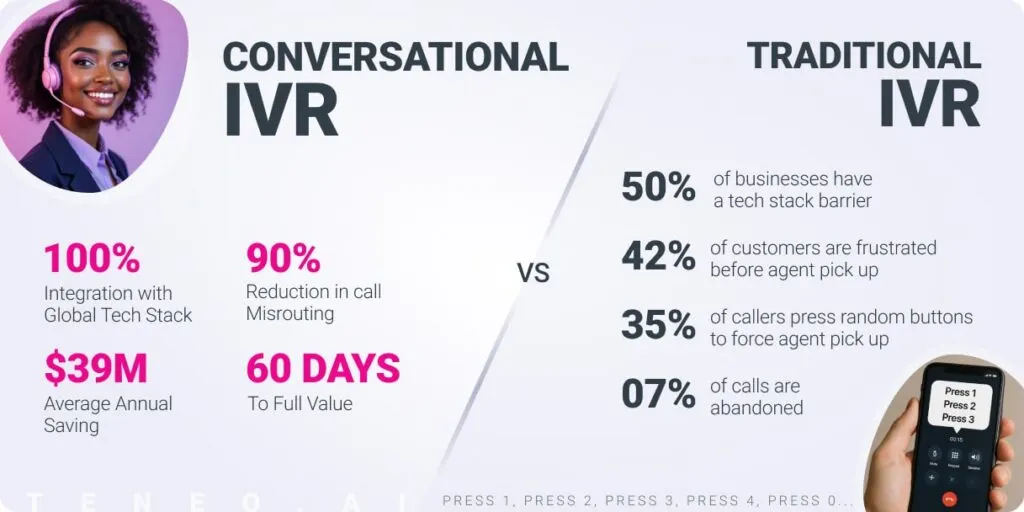
Modern voice bots are fundamentally different from traditional IVR systems. IVR routes callers through menus. A voice bot resolves their issue: authenticating the customer, pulling their account data, processing their request, and confirming the outcome — end-to-end in a single call.
Why Traditional IVR Systems Are Being Replaced
Most contact centres already have an IVR. Most have containment rates of 15–30%. The gap between what IVR could theoretically contain and what it actually does is driven by consistent, well-documented design failures:
- Menu friction: Callers who cannot find their option within the first two menu levels press ‘0’ for an agent. Complex IVR trees don’t resolve issues — they delay them.
- No natural language handling: Customers speak naturally; IVR expects specific keywords or DTMF input. When the caller says ‘I have a problem with my bill’ instead of selecting option 3, IVR fails.
- No action capability: Traditional IVR collects information but cannot take action — process a payment, update an address, reset a device — without transferring to a live agent.
- No contextual memory: Every IVR interaction starts from zero. A caller who contacted yesterday about the same issue is treated as new.
The solution is not a better IVR menu. It is conversational IVR — replacing the menu entirely with natural language understanding and agentic action capability.
How Teneo’s Voice Bot Achieves 90% Containment
The gap between a 20% IVR containment rate and a 60-90% voice AI containment rate is not incremental improvement. It requires a different technology architecture entirely.
99% intent recognition in production
Teneo’s Hybrid AI architecture — combining deterministic NLU with LLM reasoning — achieves 99% intent recognition accuracy in live production voice environments. This is not benchmark performance — it is verified across deployments including a Magnificent 7 technology company handling enterprise-scale call volumes.

Real-time backend integration
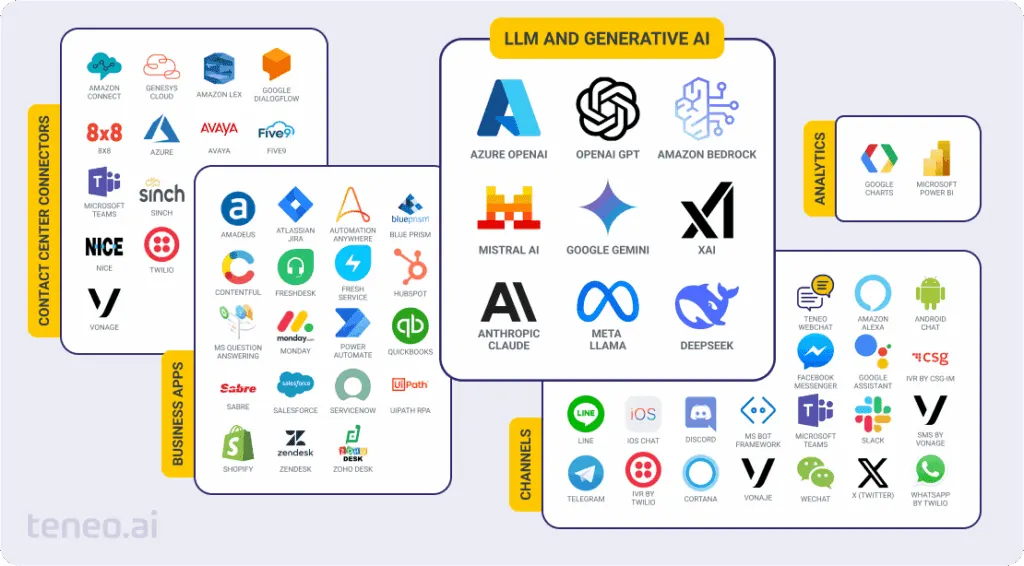
A voice bot that cannot act is a sophisticated menu. Teneo AI agents connect directly to your CRM, billing system, ticketing platform, and any other backend system — giving them the capability to complete transactions, not just collect information.
Voice-native architecture for real-world conditions
Most ‘voice AI’ platforms are chat systems with voice interfaces bolted on. Teneo Voice AI is purpose-built for enterprise phone channels — engineered for background noise, varied accents, interruptions, and the natural imperfections of real customer speech, at sub-second latency under load. For deployments serving multiple regions, multilingual voice AI extends this same accuracy across 40+ languages with native NLU per language rather than runtime translation.
Deployment: From IVR to Voice Bot in 10 Weeks
Teneo’s standard enterprise deployment timeline:
- Weeks 1: Call driver analysis, intent mapping, and scope definition. Using your actual call transcripts to identify the top use cases.
- Weeks 2-3: Agent design and build. Teneo’s no-code AI Agents enables non-engineering teams to design and configure agents without writing code.
- Weeks 3-4: Backend system integration. Direct APIs to your CRM, billing, and any other system the agent needs to take action.
- Weeks 5-9: Testing, accuracy validation, optimization, and escalation model design.
- Week 10: Go-live in production. Initial scope targeted at 3–5 top call drivers. Containment rate measured from day one.
Contact us to learn more!
Replace your IVR with a voice bot that actually resolves Teneo: 99% accuracy, 90% containment, 10-week deployment. The enterprise contact centre voice AI platform. Contact Teneo to learn more!